Skip to content

Nursing College Management Software Pakistan

Software That Knows What a Clinical Hour Is

Generic college software treats a nursing college like any other institution. It is not. Attendance splits into theory and clinical, hours are counted against a Council minimum, and the regulator is the Pakistan Nursing Council, not an accreditation body in another hemisphere.

The shortlist problem

Three Kinds of Software, None of Them Built for This

A principal looking for a system in Pakistan finds three categories of vendor, and each fails in a different direction. Knowing which failure you are buying is most of the decision.

Western clinical platforms

Built around CCNE and ACEN accreditation

Designed for United States nursing programs and priced for United States budgets. The compliance model is built around an accreditation regime Pakistan does not use, the payment assumptions are card and ACH, and the support hours sit on the wrong side of the planet. They are good products solving a different country's problem.

Indian nursing ERPs

Built around Indian Nursing Council compliance

Much closer in shape, and genuinely competent at nursing education. But the compliance engine is built for INC, not PNC, and those are different rubrics with different categories and different weights. The payment rails are UPI rather than JazzCash and Easypaisa. The support number starts with plus ninety one.

Generic Pakistani college ERPs

Built for degree colleges and universities

Local, affordable, and correctly assume how Pakistani families pay. But they model a college as classrooms and examinations. Clinical rotations are not in the data model, theory and clinical attendance collapse into one number, and PNMC reporting has to be assembled by hand in Excel afterwards, which is the job you were trying to stop doing.

Why nursing is its own problem

Four Things Generic College Software Gets Wrong

Attendance is two things, not one

A nursing student attends theory classes and clinical placements, and PNC reporting treats them separately with separate minimums. Software that stores a single attendance percentage has already lost the distinction the regulator cares about most, and no amount of reporting on top will recover it.

Hours are counted, not just marked

A student does not merely attend a rotation. They accrue hours against a program minimum, at a named hospital site, signed off by a supervisor. Graduation depends on the total. If the system records presence but not hours, the graduation audit becomes a manual reconstruction from a register.

The hospital is part of the institution

Clinical education happens somewhere the college does not own, coordinated with people the college does not employ. That needs a way for an external coordinator to confirm attendance and sign off hours without being given access to student fee records or anything else that is none of their business.

Compliance is a rubric, not a report

PNMC grades across weighted categories with individual thresholds. A system that can print an attendance report has not solved compliance. A system that scores you against the rubric, and tells you which categories sit below their threshold, has.

Why Pakistan is its own problem

The Assumptions Imported Software Gets Wrong

How families actually pay

Fees arrive as cash at the counter, a mobile wallet transfer, or a bank slip photographed and sent on WhatsApp. Software that assumes a card on file is describing a country this is not.

Where parents actually are

Not in an app. A parent portal that requires a download and a password will sit unused. WhatsApp is already on the phone and already open, which is why Clineum authenticates parents on a registered number with a code rather than a password.

What the connection is actually like

A faculty member marking attendance on a hospital ward may have no usable signal. Marking has to work offline and sync when the connection returns, or it goes back to paper and the register becomes the real system again.

Which regulator actually inspects

The Pakistan Nursing Council, on its own rubric, in its own cycle. Not CCNE, not ACEN, not INC. A compliance module built for another regulator is a compliance module you will still be doing by hand.

Before you sign anything

Twelve Questions to Ask Any Vendor

Ask these of every system you shortlist, including this one. Ask for a demonstration rather than an answer, because every vendor will say yes to all twelve and only some of them will be able to show you.

Compliance

  1. Show me my PNMC readiness score, and then click one category through to the records underneath it.
  2. Which compliance categories does the system calculate for me, and which do I have to declare and remember to update?
  3. Show me a faculty member whose PNC registration is about to expire. How did the system tell anyone?

The nursing specifics

  1. Show me theory attendance and clinical attendance as separate figures for the same student.
  2. Show me a student's clinical hours against the program minimum, with the site and the supervisor who signed them off.
  3. How does a hospital coordinator confirm attendance without seeing anything else about my students?

Money

  1. Show me a parent paying a challan the way a parent here actually pays it.
  2. When a payment lands, what does the defaulter list do, and when?
  3. Show me the reconciliation for yesterday, not a report I would have to build.

Reality

  1. Turn off the connection and mark attendance. Now turn it back on.
  2. Show me what a parent sees, on a phone, without installing anything.
  3. If we have two campuses, show me that one branch genuinely cannot see the other branch's data.
What a complete system covers

Six Modules, One Record

The point of an integrated system is not that it has more screens. It is that marking attendance moves the compliance score, and taking a payment shortens the defaulter list, without anyone exporting anything.

  • Student Information System
  • Fee Collection & Billing
  • Attendance Tracking
  • Clinical Rotation Management
  • PNC Compliance Automation
  • Blockchain Credentials
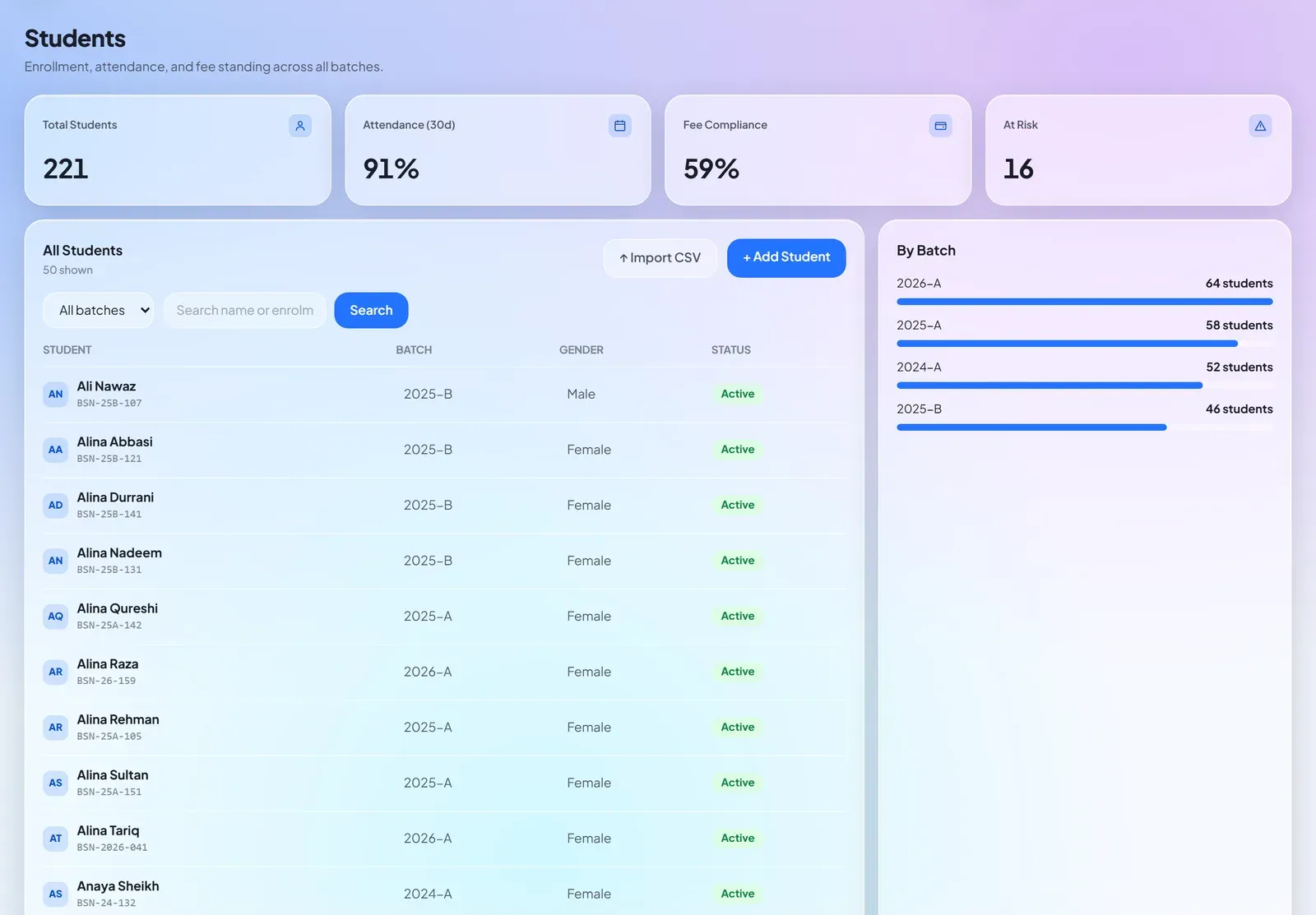
The Clineum student roster showing enrollment, 30 day attendance, fee compliance and students at risk, broken down by batch
Who signs in

One System, Three Ways In

Staff, students and families each get their own door, and each sees only what belongs to them. Enforced at the database, not in the interface.

Staff and faculty

Email and password

Principals see the institution, registrars manage enrollment, accounts staff handle fees, faculty see their own classes. Ten scoped roles in total.

Students

Email and password

Their attendance, their results, their clinical hours and their fee standing. No queue at the office to ask how many hours they are short.

Parents and guardians

Phone number and a WhatsApp code

No password to forget and nothing to install. They enter the number the college already has on file and a code arrives on WhatsApp, or by SMS if they prefer.

Your existing records

What Happens to Twenty Years of Paper

No college starts from nothing. There are registers going back years, a fee ledger somebody maintains carefully, a staff file per faculty member, and almost always a spreadsheet that one person understands. The migration question is not whether that can be imported. It is what happens when it turns out to be inconsistent, because it always turns out to be inconsistent.

Three things reliably surface in the first pass, and they are worth knowing before anyone opens a file rather than after.

The same student, twice

Duplicate enrollment numbers are the most common problem in college records, usually created when a student was readmitted, transferred between batches, or entered by two people in the same week. They are invisible in a register and obvious to an importer. Every duplicate has to be resolved as a decision, not guessed at, because merging two records that are genuinely different students is worse than leaving both.

Batches named four ways

A cohort written as 2024-A in one file, Batch A 2024 in another, and First Year in a third is three cohorts as far as any system is concerned. Normalising batch and program naming is usually the single largest piece of preparation work, and doing it before import is far cheaper than discovering it afterwards in a compliance report that splits one cohort into three.

Records that were never complete

Missing CNICs, faculty qualification documents that exist on paper but nowhere digital, clinical hours recorded in a ward register that never made it into any central file. Importing does not create data that was never captured. What it does is show you precisely which records are incomplete, which is the first time most colleges see that list in one place.

None of this is a reason to delay. It is a reason to start the data work in the first week rather than the last, which is why discovery and configuration come before migration in the schedule rather than alongside it. A college that spends three days normalising batch names has bought itself a clean compliance position for every year that follows.

What stops

The Jobs That Go Away

Rebuilding attendance at month end

The register is the report. Nobody assembles a monthly return from paper, because the return is already written by the time anyone asks for it.

Chasing fee slips on WhatsApp

A challan paid at an agent closes itself. The defaulter list shortens without anyone reconciling a photograph of a bank slip against a ledger.

Counting clinical hours by hand

Hours accrue per student against the program minimum as rotations are logged, so the graduation audit is a query rather than an afternoon with a calculator.

Discovering an expired registration at inspection

A faculty PNC registration approaching expiry surfaces while there is still time to renew it, which is the entire difference between a finding and a non event.

Guessing which categories are short

The readiness score names them, with the weight attached, so effort goes where the marks are rather than where the anxiety is.

Explaining to parents what they missed

Attendance digests and fee reminders go out automatically on the channel families already use, so the office stops being a message relay.

Multi campus and security

One Dashboard, Genuine Separation

An institution running several campuses has a real problem that sounds administrative and is actually architectural. Head office needs the consolidated position. A branch principal needs their own students and nobody else's. If separation is enforced in the interface, by hiding menu items, it is not separation. It is a curtain.

Clineum enforces it at the database with row level security, so a query issued on behalf of one branch cannot return another branch's rows even if the application asks it to. Ten scoped roles run from super admin down to parent, and a parent reaches exactly one student's record. Every permission boundary sits at the same level as the data rather than on top of it.

This is worth testing rather than believing. Ask any vendor to show you a user who should not be able to see something, and then watch them try.

Common questions

What Principals Ask Before They Shortlist

What is the best nursing college management software in Pakistan?

The honest answer is that it depends on what you are failing at now. If your problem is PNC reporting, judge systems on whether they score you against the rubric rather than print attendance. If it is fee collection, judge them on whether a parent can pay the way parents here actually pay. If it is clinical coordination, judge them on whether hours are counted against the program minimum with a supervisor signature. Use the twelve questions above on every vendor you shortlist, including Clineum, and buy the one that can demonstrate rather than assert.

Can we not just use a normal college ERP?

You can, and many nursing colleges do. What you inherit is a data model with no concept of a clinical rotation, a single attendance figure where PNC expects two, and hours that live in a register rather than in the system. None of that stops the college running. It means compliance reporting stays a manual exercise every year, which is usually the thing that prompted the search in the first place.

What does nursing college software need to do that university software does not?

Separate theory from clinical attendance, count clinical hours against a Council minimum per student, coordinate placements at hospital sites with external supervisors, and score the institution against the PNMC accreditation rubric. Those four requirements do not exist in general higher education software because general higher education does not have them.

Does it work with more than one campus?

Yes. Each branch is isolated at the database level with row level security, so a branch sees only its own students, faculty and fees, while headquarters sees the consolidated position. Compliance is scored per program and per branch, because a newer campus and an established one are rarely in the same state of readiness.

How long does it take to move a college across?

Two weeks from signup for a typical single campus institution: three days for discovery and configuration, four for migrating your existing student, faculty and fee records, three for training every user group, then launch with thirty days of close support. Multi campus institutions with large historical data sets take longer, and that gets said during discovery rather than after you have signed.

Is Clineum available outside Karachi?

Yes. It is built in Karachi by Globotech Solutions and used across Pakistan. Implementation is run remotely or on site depending on what suits, and training is conducted in Urdu or English. The Karachi base matters mainly for support hours, which sit in your working day rather than someone else's.

Ready when you are

Run the Twelve Questions Against Us

Book a walkthrough and put every question on that checklist to the product directly, using your own batches, fee heads and inspection rubric.