
Skip to content

PNC Compliance Software

Walk Into Inspection Already Ready

Clineum scores your college against the PNMC accreditation rubric continuously, category by category, from the attendance and faculty records you are already keeping. The report is written before the letter arrives.

The annual scramble

Compliance Is Not a Month. It Is a State.

Every principal knows the shape of it. The letter from the Pakistan Nursing Council arrives three or four weeks before the inspection date, and the institution stops being a college for a while. Faculty stop teaching and start opening filing cabinets. The registrar prints attendance registers at midnight. Somebody discovers that two faculty registrations lapsed in March and nobody noticed because nothing was watching.

By inspection day everyone is exhausted, the file is thick, and the college is graded on three weeks of frantic assembly rather than on how it actually runs. That is the part worth sitting with. The inspection is not measuring your institution. It is measuring your filing.

Colleges that pass comfortably are rarely better colleges. They are better organised ones. They have worked out that readiness is not something you build in the three weeks before inspectors arrive. It is the residue of keeping proper records all year, which is a software problem long before it is a discipline problem.

What is actually measured

The Twelve Categories, and What Each One Is Worth

Clineum grades a program against the PNMC accreditation rubric as twelve weighted categories. The weights sum to one hundred, and each category carries its own passing threshold rather than a single blanket standard. Knowing the weights changes where you spend your effort: physical infrastructure across the college and its affiliated hospitals is worth thirty of the hundred marks between them, while extra curricular activities and public disclosure together are worth five.

The twelve PNMC accreditation categories with their weights, passing thresholds and evidence source
CategoryWeightThresholdSource
Organization & Governance10%80%Attested
Physical Infrastructure (School/College)15%80%Attested
Physical Infrastructure (Parent/Affiliated Hospitals)15%80%Attested
Faculty & Staff10%70%Computed
Academic Process & Evaluation10%50%Computed
Teaching and Learning Resources10%60%Attested
Auxiliaries10%50%Attested
Financial Management5%70%Attested
Research & Publication5%50%Computed
Quality Control5%30%Attested
Extra-Curricular Activities3%30%Attested
Public Disclosure and Transparency2%30%Attested
Total100%

Weights and thresholds as graded in Clineum. Confirm the current rubric against the PNMC circular in force for your inspection year before you rely on any single figure.

Attested and computed

Two Kinds of Evidence, and Only One of Them Can Go Stale

Every category in the rubric is scored from one of two places, and the distinction is the whole argument for doing this in software.

An attested category is one you declare. Your building has a skills laboratory of a certain size, your library holds a certain number of titles, your governance structure is constituted a certain way. You state it, you attach the evidence, and it stands until the facts change. Attestation is honest work, but it is a snapshot, and a snapshot taken in January can quietly stop being true by October.

A computed category is one nobody declares. It is derived from what the college did. Faculty and staff scores read your actual appointment records and your real student to faculty ratio. Academic process and evaluation reads the sessions you actually held and the marks you actually entered. Research and publication reads what has actually been recorded. Nobody types the number in, so nobody can forget to update it, and nobody can flatter it.

That is the shift. The categories most likely to embarrass a college at inspection are precisely the ones that depend on records accumulating correctly week after week, and those are exactly the ones Clineum computes rather than asks you to remember.

The number itself

One Score, Broken Into Its Parts

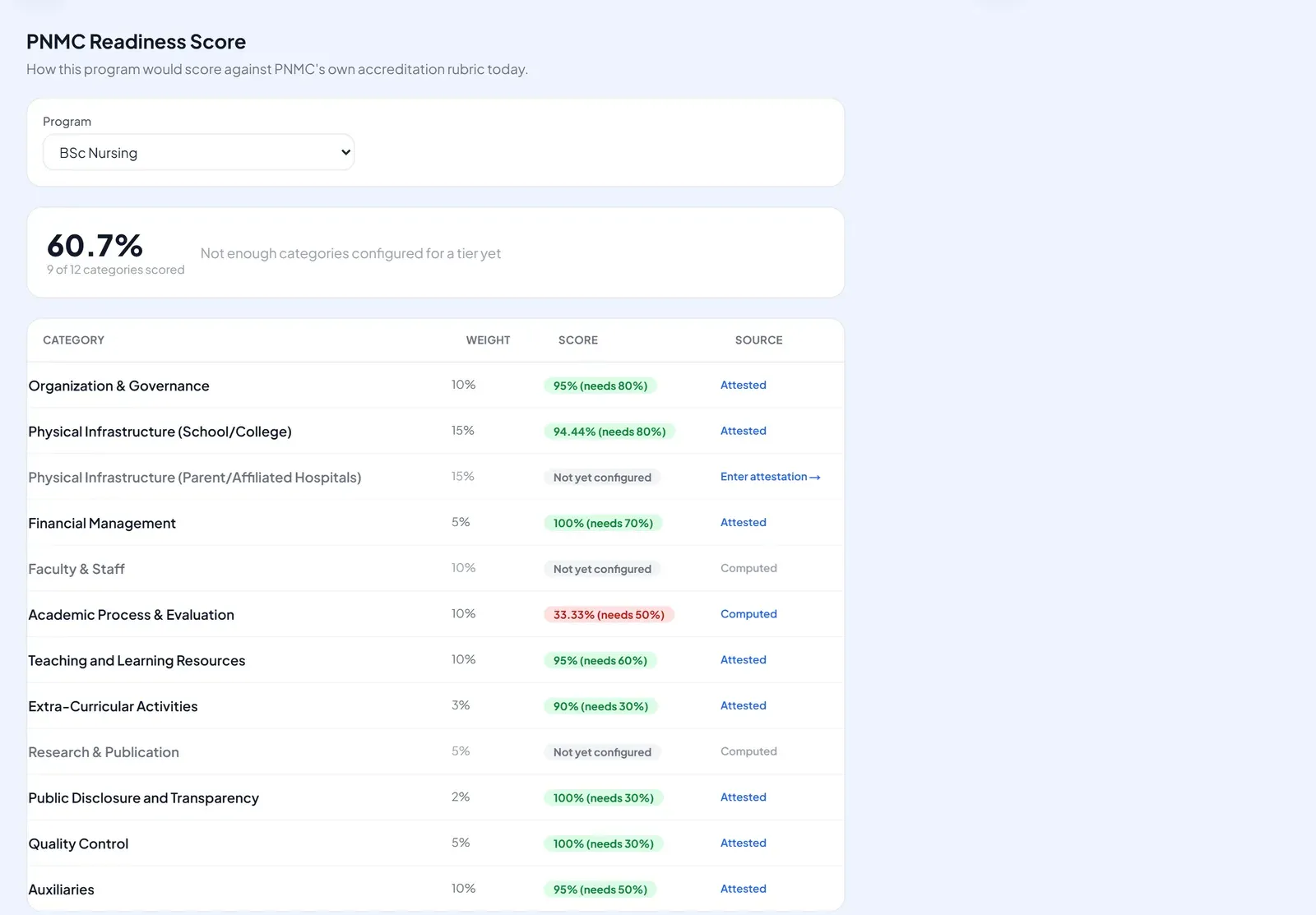
The readiness score is a single weighted percentage with the arithmetic left visible. You see which categories are scored, which are still unconfigured, which are above their threshold and which are below it, and where each figure came from. A college sitting at sixty percent with nine of twelve categories scored is not failing. It is a college that knows exactly which three categories to work on next, which is a materially different position from knowing only that inspection is in five weeks.

  • Scored per program, because a BSc and a Post RN cohort are inspected separately
  • Each category shows its weight, its score, and the threshold it has to clear
  • Below threshold categories surface in red rather than being buried in an average
  • Unconfigured categories are named, so the gap is visible instead of silently missing
  • Every computed figure traces back to the operational record that produced it
The Clineum PNMC readiness screen showing a 60.7 percent score across nine of twelve scored categories, each with its weight, score against threshold, and whether it was attested or computed
The readiness screen, scored per program, with the arithmetic left visible.
Where the numbers come from

Three Categories Nobody Has to Remember to Update

Nine of the twelve categories are attested. Three are computed, and those three are the ones that move without anyone touching them. Here is exactly what each one reads.

Faculty & Staff

10% of the total
  • Current appointments, not a headcount typed in last year
  • PNC registration status and expiry date per faculty member
  • Qualification records held against the person, with attested copies
  • Student to faculty ratio, recalculated as enrollment changes

A ratio is a moving number. It changes with every intake and every resignation, and a college comfortably within the standard in March can be outside it by September without a single person noticing. Computing it means the score moves on the day the facts move, not on the day somebody checks.

Academic Process & Evaluation

10% of the total
  • Sessions actually held, against the sessions scheduled
  • Theory and clinical attendance, tracked separately
  • Examinations conducted and marks entered per paper
  • Internal assessment completeness across the cohort

This is the category that catches colleges out, because it cannot be assembled retrospectively with any honesty. Either the sessions were recorded when they happened or they were not. It is also why the attendance register and the compliance report have to be the same record, rather than two records that are supposed to agree.

Research & Publication

5% of the total
  • Publications recorded against faculty members
  • Research activity logged during the assessment period

The smallest of the three, and the one most often sitting at zero simply because nobody kept a list. Five marks is not nothing when the gap between one tier and the next is frequently a handful of points.

Score and file

Knowing Your Number Is Not the Same as Proving It

A readiness score tells you where you stand. It does not, on its own, satisfy an inspector, and it would be dishonest to suggest otherwise. What an inspection actually consumes is evidence: the appointment letter, the attested qualification copy, the attendance register for a named month, the clinical hour log with a supervisor signature against it.

So the score and the file have to be the same thing viewed two ways. When a category reads ninety five percent, the useful question is not whether you believe the number. It is whether you can produce, in the room, the twenty records that produced it. If the score lives in one system and the evidence lives in a cabinet, you have bought a dashboard rather than compliance.

That is the test worth applying to any vendor in this category, including this one. Ask to see a score. Then ask to click through the score and reach the underlying records. If that path does not exist, the number is decoration.

More than one program

Each Program Is Inspected on Its Own Terms

A college running a BSc Nursing cohort alongside a Post RN program does not have one readiness position. It has two, and they are frequently not close to each other. A newer program can be short on research output and academic process while the established one sits comfortably, and an average across both describes neither while hiding the one that needs attention. Clineum scores per program for exactly that reason. Multi campus institutions get the same separation by branch, with row level security ensuring each branch sees only its own data while headquarters sees the consolidated position.

What stops being manual

The Work This Actually Removes

Faculty qualification tracking

Every faculty member's PNC registration, qualification and appointment documentation is held against their record with expiry dates attached. A registration approaching lapse surfaces before it lapses rather than during an inspection.

Student to faculty ratio

Computed continuously from live enrollment and current appointments rather than assembled from a spreadsheet the week before. If an intake pushes the ratio past the standard, the score moves the day it happens.

Attendance evidence

Theory and clinical attendance are recorded separately, which is the distinction PNC reporting turns on and the one generic education software collapses. The register is the report.

Clinical hour logs

Hours recorded per student against the program minimum, at the hospital site where they were completed, with the supervisor who signed them off. The graduation audit and the inspection file are the same record.

Infrastructure attestations

Held with their evidence and their date, per category, so an attestation made two years ago is visibly two years old rather than silently assumed current.

Inspection history

Past inspections, the findings raised and the remediation completed against each, so the next inspector is answered from a record rather than from memory.

If the letter has already arrived

The Thirty Days Before an Inspection

This is the sequence that works when time is short. It is also the sequence that stops being necessary once readiness is continuous.

  1. 1

    Find out where you actually stand

    Days 1 to 5

    Score every program against the rubric and list the categories below threshold. Do not start with the categories that feel urgent. Start with the ones carrying the most weight, because a fifteen percent category three points short costs you more than a three percent category failing outright.

  2. 2

    Close the documentation gaps

    Days 6 to 14

    Faculty registrations, appointment letters, attested qualification copies, CNIC records. This is where most colleges lose marks, and it is the most recoverable ground on the list because it is paperwork rather than construction.

  3. 3

    Reconcile the operational record

    Days 15 to 22

    Attendance, clinical hours and examination records against what you will present. Anything that cannot be reconciled now will be found by an inspector later, and it is a far better conversation when you raise it first.

  4. 4

    Assemble and rehearse

    Days 23 to 30

    Generate the reports, brief the people who will be asked questions, and walk the building as an inspector would. The file should be able to answer a question without anyone leaving the room to look for a folder.

Common questions

What Principals Ask Before They Switch

What software does the Pakistan Nursing Council require?

PNC does not mandate a specific software product. It requires that a recognised institution can produce evidence across the accreditation categories, including faculty qualification records, student attendance, clinical hour logs and infrastructure documentation. Any system that holds those records reliably and can report on them will satisfy an inspection. The question that actually matters is whether your records are complete and current on the day you are asked, not which vendor holds them.

How is the PNMC readiness score calculated?

It is a weighted percentage across twelve categories whose weights sum to one hundred. Each category carries its own passing threshold rather than a single blanket standard. Some categories are attested, meaning the college declares them with supporting evidence. Others are computed directly from operational data already in the system, such as appointment records, attendance and marks entered. The score shows which categories are scored, which are unconfigured, and which sit below their threshold.

Does this replace the PNC inspection itself?

No, and any vendor telling you otherwise is selling you something that does not exist. Inspection is conducted by the Council. What this changes is the position you are in when inspectors arrive: whether you are discovering your gaps in front of them or have known about them for months and closed them.

We already keep all of this on paper and in Excel. Why change?

Because paper and spreadsheets are perfectly capable of holding the right information and completely incapable of telling you when it stops being right. A faculty registration expires silently. A ratio drifts past the standard with the next intake and nothing announces it. The value is not storage, which you already have. It is the system noticing before an inspector does.

Can it score more than one program?

Yes. Readiness is scored per program, because a BSc Nursing cohort and a Post RN cohort are assessed separately and can sit at genuinely different levels of readiness. A college running several programs sees each one on its own terms rather than averaged into a single number that describes none of them.

How long before a new college is producing usable reports?

Two weeks from signup for a typical single campus institution, covering discovery and configuration, migration of your existing student and faculty records, and training. Attested categories can be entered immediately. Computed categories become meaningful as soon as operational data starts accumulating, which begins on the first day attendance is marked.

Ready when you are

See Your Own Readiness Score

Book a walkthrough and we will score one of your programs against the rubric using your own faculty and attendance records.